Showing posts with label Christianity. Show all posts

Apr 16, 2012

Христос воскресе!

И така на още много езици. 

Снощи ходих на среднощна великденска служба в руската църква. Доста беше сюрреалистично, но това е отчасти защото много отдавна не бях ходила на великденска служба. За пръв път оставих децата да спят сами вкъщи, отидох към 11 ч. и се прибрах към 1. Църквата е съвсем мъничка, съответно препълнена, но в сравнение със спомените ми от България, нямаше никакви хора:) Руснаците пеят великденския тропар по различен начин и в хора им са само жени. Освен това свещеникът извика "Христос воскресе" на 6 езика преди полунощ, което накара компанията, в която бях, да се зачуди дали не го посрещаме по московско време. Ама не, беше към 12 без 20. Руснаци, какво да ги правиш, не ги разбирам. А, и бях забрадена с шал. Споменах ли, че не ги разбирам?

Същия ден прекарахме общо 14 часа на път - летяхме през Брюксел, но заради мъгла самолетът кацна в Остенде, където чакахме времето да се оправи, за да се върнем в Брюксел. Оттам още 3 часа с влак до Люксембург. Мъчително, особено за котарака Рафи в клетката му, но и за нас с децата също. Важното е, че се прибрахме живи и здрави у дома и Рафи веднага се скри под дивана, където престоя няколко часа и нито яде, нито пи. Днес обаче вече си научи тоалетната, храната и леглото ми. Когато живеехме заедно, не му позволявах да спи при мен или при децата, но след като толкова време го бяхме оставили сам, мисля, че му дължим малко повече глезотии. Особено ако си точи ноктите на специалното място на "котешкото дърво", а не по мебелите... С децата сме много щастливи, че Рафи е отново с нас, а честно казано мисля, че и той също. 

В България много ми хареса, но ми беше студено. Накупих си български книги, засега съм прочела "18% сиво" от Захари Карабашлиев, "Физика на тъгата" от Георги Господинов и сборника с разкази "На изток от запада" от Мирослав Пенков. Последната ме впечатли най-много (непременно ще я прочета и на оригиналния английски), но и другите две са много добри. Не разбирам нищо от фотография, че да оценя както подобава първата, но пътуването през Америка е описано чудесно въпреки това, а втората е малко прекалено митологично-философски наситена, но пък аз се радвам на такива неща. Едва на финала става леко претенциозна, но това е простимо. Сега ми предстои "Възвишение" от Милен Русков.

През цялото време в София обикалях по административни задачи и се срещах с хора. Естествено, нито свърших всичко, което ми трябваше, нито се срещнах с всички, с които исках, но такъв е животът на емигранта, не е оттук и е за малко.

Mar 31, 2008

Beyond the Dark Sun

Защото нашето спасение е в надежда. А надеждата за онова, което се вижда, не е надежда, понеже, защо ще се надява някой за нещо, което вижда?
Кога пък се надяваме за онова, което не виждаме, с търпение го очакваме.
Послание към Римляните

"Нашето спасение е в надежда" е основната тема на енцикликата на папа Бенедикт ХVІ от 30.11.2007 г., която е преведена тук, но не може да се копира от сайта без разрешение, затова ще цитирам от английския вариант. Бенедикт пише завладяващо и убедително, направо ми е жал да го резюмирам. Ето основните точки от енцикликата:

1. Вярата е надежда.

So now we can say: Christianity was not only “good news”—the communication of a hitherto unknown content. In our language we would say: the Christian message was not only “informative” but “performative”. That means: the Gospel is not merely a communication of things that can be known—it is one that makes things happen and is life-changing. The dark door of time, of the future, has been thrown open. The one who has hope lives differently; the one who hopes has been granted the gift of a new life.

2. Разбирането на вярата и надеждата в Новия Завет и в ранната църква.

The figure of Christ is interpreted on ancient sarcophagi principally by two images: the philosopher and the shepherd. Philosophy at that time was not generally seen as a difficult academic discipline, as it is today. Rather, the philosopher was someone who knew how to teach the essential art: the art of being authentically human—the art of living and dying. To be sure, it had long since been realized that many of the people who went around pretending to be philosophers, teachers of life, were just charlatans who made money through their words, while having nothing to say about real life. All the more, then, the true philosopher who really did know how to point out the path of life was highly sought after.

3. Вечният живот - какво е това?

“Eternal”, in fact, suggests to us the idea of something interminable, and this frightens us; “life” makes us think of the life that we know and love and do not want to lose, even though very often it brings more toil than satisfaction, so that while on the one hand we desire it, on the other hand we do not want it. To imagine ourselves outside the temporality that imprisons us and in some way to sense that eternity is not an unending succession of days in the calendar, but something more like the supreme moment of satisfaction, in which totality embraces us and we embrace totality—this we can only attempt. It would be like plunging into the ocean of infinite love, a moment in which time—the before and after—no longer exists. We can only attempt to grasp the idea that such a moment is life in the full sense, a plunging ever anew into the vastness of being, in which we are simply overwhelmed with joy.

4. Индивидуалистична ли е християнската надежда?

Indeed, the Letter to the Hebrews speaks of a “city” (cf. 11:10, 16; 12:22; 13:14) and therefore of communal salvation. Consistently with this view, sin is understood by the Fathers as the destruction of the unity of the human race, as fragmentation and division. Babel, the place where languages were confused, the place of separation, is seen to be an expression of what sin fundamentally is. Hence “redemption” appears as the reestablishment of unity, in which we come together once more in a union that begins to take shape in the world community of believers.

5. Преобразяването на християнската надежда в новото време.

If progress, in order to be progress, needs moral growth on the part of humanity, then the reason behind action and capacity for action is likewise urgently in need of integration through reason's openness to the saving forces of faith, to the differentiation between good and evil. Only thus does reason become truly human. It becomes human only if it is capable of directing the will along the right path, and it is capable of this only if it looks beyond itself.

6. Истинският образ на християнската надежда.

Day by day, man experiences many greater or lesser hopes, different in kind according to the different periods of his life. Sometimes one of these hopes may appear to be totally satisfying without any need for other hopes. Young people can have the hope of a great and fully satisfying love; the hope of a certain position in their profession, or of some success that will prove decisive for the rest of their lives. When these hopes are fulfilled, however, it becomes clear that they were not, in reality, the whole. It becomes evident that man has need of a hope that goes further. It becomes clear that only something infinite will suffice for him, something that will always be more than he can ever attain. In this regard our contemporary age has developed the hope of creating a perfect world that, thanks to scientific knowledge and to scientifically based politics, seemed to be achievable.

Места за обучение и упражняване в надежда:

- молитвата

To pray is not to step outside history and withdraw to our own private corner of happiness. When we pray properly we undergo a process of inner purification which opens us up to God and thus to our fellow human beings as well. In prayer we must learn what we can truly ask of God—what is worthy of God. We must learn that we cannot pray against others. We must learn that we cannot ask for the superficial and comfortable things that we desire at this moment—that meagre, misplaced hope that leads us away from God.

When we ask such a question, we should recall that no man is an island, entire of itself. Our lives are involved with one another, through innumerable interactions they are linked together. No one lives alone. No one sins alone. No one is saved alone. The lives of others continually spill over into mine: in what I think, say, do and achieve. And conversely, my life spills over into that of others: for better and for worse. So my prayer for another is not something extraneous to that person, something external, not even after death. In the interconnectedness of Being, my gratitude to the other—my prayer for him—can play a small part in his purification.

- делата и страданието

The true measure of humanity is essentially determined in relationship to suffering and to the sufferer. This holds true both for the individual and for society. A society unable to accept its suffering members and incapable of helping to share their suffering and to bear it inwardly through “com-passion” is a cruel and inhuman society. Yet society cannot accept its suffering members and support them in their trials unless individuals are capable of doing so themselves; moreover, the individual cannot accept another's suffering unless he personally is able to find meaning in suffering, a path of purification and growth in maturity, a journey of hope. Indeed, to accept the “other” who suffers, means that I take up his suffering in such a way that it becomes mine also. Because it has now become a shared suffering, though, in which another person is present, this suffering is penetrated by the light of love. The Latin word con-solatio, “consolation”, expresses this beautifully. It suggests being with the other in his solitude, so that it ceases to be solitude.

- възмездието

The atheism of the nineteenth and twentieth centuries is—in its origins and aims—a type of moralism: a protest against the injustices of the world and of world history. A world marked by so much injustice, innocent suffering, and cynicism of power cannot be the work of a good God. A God with responsibility for such a world would not be a just God, much less a good God. It is for the sake of morality that this God has to be contested. Since there is no God to create justice, it seems man himself is now called to establish justice. If in the face of this world's suffering, protest against God is understandable, the claim that humanity can and must do what no God actually does or is able to do is both presumptuous and intrinsically false. It is no accident that this idea has led to the greatest forms of cruelty and violations of justice; rather, it is grounded in the intrinsic falsity of the claim. A world which has to create its own justice is a world without hope. No one and nothing can answer for centuries of suffering. No one and nothing can guarantee that the cynicism of power—whatever beguiling ideological mask it adopts—will cease to dominate the world.

Ще взема да прочета и предишните енциклики. На последната попаднах благодарение на този пост на Размисли.


Mar 25, 2008

Blood of Faith Stains My Hands

Статията "10 неща, за които християни и атеисти могат (и трябва) да се съгласят" е тук. Много забавно е написана и има яки картинки, обидни за всички, които се вземат насериозно.

За много мързеливите (и понеже имам много работа), ето десетте неща:

1. Злини могат да се вършат в името и на двата светогледа.
2. И двете страни вярват в това, което казват.
3. В ежедневието не сте чак толкова различни.
4. И от двете страни има читави хора.
5. Вашата гледна точка напълно основателно е обидна за тях.
6. Склонни сме да преувеличаваме за "врага".
7. Склонни сме да преувеличаваме и за "нашите".
8. Съсредоточаването върху негативни примери води до оглупяване.
9. И двете страни са дали по нещо добро на света.
10. Няма да успеете да премахнете другите с тормоз.

Сега ако бях един рентиер, щях да преведа статията безвъзмездно. Ама не съм. Приятно четене:)


Mar 23, 2008

Midway Through Infinity

Не са били скрити от Тебе костите ми, когато съм бил създаван тайно,
образуван в дълбочината на утробата.
Твоите очи видяха зародиша ми;
в Твоите книги са записани всичките назначени за мене дни,
когато нито един от тях още не съществуваше.
Псалом 138

Днес католиците празнуват Възкресение Христово - повече от месец по-рано от православните. Не им разбирам календарните различия, нещо с луни и съботи е свързано. За всичко са виновни евреите:Р

Неприкосновеността и достойнството на човешкия живот присъстват в реториката на всеки уважаващ себе си политик от 21 век. В момента в британския парламент се гласува проектозакон за разрешаване на опитите върху хибридни ембриони между животно и човек, от които да се вземат стволови клетки за изследвания. Повечето католици са се обявили против и шотландският архиепископ кардинал О'Брайън включва темата във великденската си проповед.

Процедурата включва прехвърляне на човешка ДНК от обикновена клетка в животинска яйцеклетка, от която е отстранена "по-голямата част от генетичната информация". Не става дума за истински хибридни организми с човешка и животинска сперма и яйцеклетка. Хибридният организъм се нарича химера. Първите подобни експерименти се правят в Китай.

За протокола, стволови клетки могат да се получат и по други начини, освен от ембриони, примерно от пъпната връв на новородени бебета. Предполагам от ембриони е по-евтино.


Jul 13, 2007

The Donkey and the Water

Знаете онзи лаф, дето можеш да заведеш магарето при водата, но не можеш да го накараш да пие. Е, аз с моя магарешки инат съм го чувала по най-различни поводи - но последно го прочетох в тази дискусия в Амазон.

Но първо малко контекст, общата тема е за враждебността на новите атеисти към религията (от мен за тях тук). Конкретната подтема е за условията за формиране на "мнения" и "убеждения" у индивидите в обществото като цяло и в образованието конкретно. Говори се, че религиозното образование "индоктринира" децата и им вменява чувство за вина от най-ранна възраст, което води до негативни последствия за личността и за това са виновни родителите, които ги водят на неделно училище примерно. Мнозина от нас обаче си спомнят друг вид индоктриниране през 70-те и 80-те години - включително атеистично - но все пак не всички сме диви комунисти, нали така? (А през лятото на 2007 г. някои не си купуват играчката на Апъл, дори да могат да си го позволят.) Доколко сме продукт на външни влияния и доколко - на собствена свобода е тема за дълги философски дискусии и винаги е било. Който отсече "мнението" си в две изречения и го възвиси до статут на универсална истина (дори когато мнението му е, че универсална истина няма), е невежо магаре. Ето, аз си отсякох мнението в едно изречение:D

По общата тема мога да вметна, че не съм живяла в САЩ и не мога да преценя до каква степен религията влияе върху живота на средния човек и дали наистина враждебността на атеистите е естествена реакция на заливащата ги религиозна пропаганда. Като чета и гледам обаче ми се струва, че светът е място, където религията е все по-маловажна, особено християнството. Говорих си с приятел, който живее там и твърди, че хората са повсеместно религиозни и тъпи - хайде сега ние да сме умни и да сме атеисти. Много ви моля... (И да, виждала съм "научно изследване" за корелацията между религиозност и интелект. Което говори зле за интелекта на провелите го учени.) Всъщност на повечето тъпи хора хич не им дреме за живота и вселената, а гледат да си натъпчат корема и да си направят шопинга, ама това е друга тема. Проблемът на американците според мен е в консуматорството, което не се насърчава от религията, даже напротив.

Постът е провокиран от този цитат в полза на свободата на индивида от оковите на "възпитанието", който ме кефи много.
Why would you want to "make" a donkey drink? If he is thirsty, he will go looking for water on his own, or you can guide him towards it. Thirst is donkey's business, not yours! If you want to assume he is thirsty when he is not and want to push water, he has his choice to resist or he might prefer, not your water, but from somewhere else. Unless you think the water you are offering is the only healthy one that he can find anywhere and he must drink even if he is not thirsty, then, you are nothing but trouble to the donkey; sometimes, even if water is good, too much of it is not.

I have trouble accepting this "indoctrination" thing, unless you can produce some valid data supporting it; it seems to give too much credit for the immutability of parental influence and not the kids themselves. Would this mean that parents are influencing their kids in their other self-destructive behavior like drugs, alcohol, tobacco, premarital sex, etc. and nothing to do with the kids themselves?

За възпитанието (и гена) на моите деца пиша непрекъснато;) А в дискусията на едно място се споменава, че the self mutates more than once in the course of life. И си стискаме ръцете с еволюционистите:)

Oct 24, 2006

My God Is Bigger Than That

A long and winding article on why New Atheism, as voiced by Richard Dawkins (mentioned also in this post), is a fundamentalist, and ultimately limiting worldview.

"...the big war is not between evolution and creationism, but between naturalism and supernaturalism. The sensible" -- and here he pauses to indicate that sensible should be in quotes -- "the 'sensible' religious people are really on the side of the fundamentalists, because they believe in supernaturalism. That puts me on the other side."

More: "Highly intelligent people are mostly atheists," he says.

I can't even bother to comment. The article touches on the possibility of religion of reason (been there, done that, French revolution, anyone?), but then cringes in the face of incompatibility of reason and emotions. In the final analysis, it asks 'What is true?'. But then the very concept of truth is an ultimate statement, and in the 21st century we speak of truths and multiple interpretations. Is this enough? Personally, I think that as long as we search for truth, we (consciously or not) search for God.

Two interviews from salon, one with an atheist, another with a Christian.

Jul 26, 2006

Politics of Truth

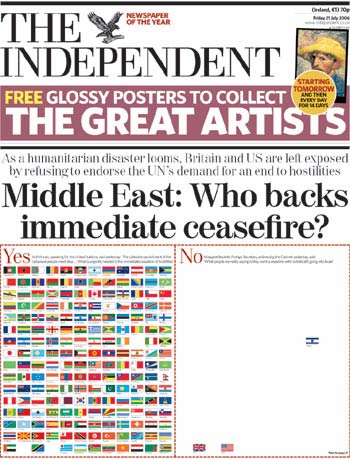
Sometimes an image is worth a thousand words.

Edit: Being a creature of language, here's something vaguely political. I will try to stay within 1000 words.

Ikew and I once discussed the troubling paradox of me being cool and a Christian. I told him I'm a lame Christian which probably explains why I'm cool, but I'd rather be a lame Christian than a leet atheist. In fact, I'd rather be a lame Buddist, Muslim, Taoist, Hindu etc. than a leet atheist. On second thoughts, if I had to be a Jew, I'd rather be a leet Jew. You have to be a leet Jew, it's part of the self-identification. They are the chosen people, after all.

The first Christians were Jewish, and the relationship between the two religions has always been problematic, starting from the Letter to Romans by the apostle Paul (part of the New Testament for the ignorant;):

I am not ashamed of the gospel, because it is the power of God for the salvation of everyone who believes: first for the Jew, then for the Gentile.
There will be trouble and distress for every human being who does evil: first for the Jew, then for the Gentile.

And of course one of my favorite quotes:

There is neither Jew nor Greek, slave nor free, male nor female, for you are all one in Christ Jesus.

In other words, even the early Church felt the ambiguity of the Jewish roots of their religion, especially when Christ repeatedly emphasized that the Law and the Prophets (Old Testament for the ignorant;) are an integral part of his teaching. I found this enlightening quote in Wikipedia:

...the very presence of the Jewish people in the world, continuing to believe in the faithfulness of God to the original covenant ... puts a great question against Christian belief in a new covenant made through Christ. The presence of this question, often buried deep in the Christian mind, could not fail to cause profound and gnawing anxiety. Anxiety usually leads to hostility.

William Nicholls
Christian Antisemitism: A History of Hate

On antisemitism I can't help quoting this, especially moving when said by Al Pacino.

I am a Jew. Hath not a Jew eyes? hath not a Jew hands, organs, dimensions, senses, affections, passions? fed with the same food, hurt with the same weapons, subject to the same diseases, healed by the same means, warmed and cooled by the same winter and summer, as a Christian is? If you prick us, do we not bleed? if you tickle us, do we not laugh? if you poison us, do we not die? and if you wrong us, shall we not revenge? If we are like you in the rest, we will resemble you in that.

W. Shakespeare, The Merchant of Venice

(Revenge is a powerful meme in the memetic pool of humanity, but it is a dirty word in politics so I'll leave it out.)

The antithesis of antisemitism, so to speak, is Christian Zionism. This is the political 'arm' of the theological belief that at the end of times before the Second Coming, certain events have to take place. These events are inferred from the Book of Apocalypse (part of the New Testament;), a frightfully complex, symbolic, metaphorical, and poetic work. A number of interpreters have suggested various scenarios, some laughable, others less so. One of the notable 'fulfilled prophecies' we are painfully reminded of in the last 57 years, is the restoration of Israel. USA played an important role in the creation of the state of Israel, one motive being precisely the Christian Zionism. It features prominently in neo-conservative ideology to the present day, although disguised in different wording. The rest is history, as they say. It is being written even now, in Lebanon and Israel.

The sentiments of the Jews about Eretz Yisrael are a different story altogether. After all, their leetness is deeply interwoven with this tiny bit of land. I already understand patriotism, although I don't feel it. Now I'm interested only in the Christian attitude to the issue, and the part of the creed that says: "and he shall come again, with glory, to judge both the quick and the dead; whose kingdom shall have no end." I believe in the end of history, as we know it. I however firmly disbelieve in attempts to arrange history to suit someone's political agenda, claiming that this is God's will.

In the words of Jesus: No one knows about that day or hour, not even the angels in heaven, but only the Father.

Finally, I was scolded by some friends for not having an opinion, and this time I am happy to announce I do have an opinion. It coincides with the Catholic view on the topic:D


On July 20, the Holy See Press Office issued a declaration on the Lebanon crisis.

“Facing the aggravation of the situation in the Middle East, the Press Office of the Holy See has been authorized to communicate the following:

  1. The Holy Father is following the fate of all the populations involved with great concern, and has indicated the next Sunday, July 23, as a special day of prayer and penance, inviting pastors and faithful of all the particular churches as well as all believers in the world to implore God for the precious gift of peace.
  2. In particular, the Supreme Pontiff hopes that prayer will be raised to the Lord for an immediate cease-fire between the parties, that humanitarian corridors will immediately be created to bring help to the suffering populations, and that rational and responsible negotiations will begin for bringing an end to the objective situations of injustice which exist in that region, as already indicated by Pope Benedict XVI in his Angelus of last Sunday, the 16th of this month.
  3. In reality, the Lebanese have the right to see the integrity and sovereignty of their country respected, the Israelis have the right to live in peace in their state and the Palestinians have the right to have a free and sovereign nation.
  4. In this painful moment, His Holiness addresses an appeal to charitable organizations to help all the populations struck by this bitter conflict."
Hint: Praying can be done anytime, anywhere.